OUR HISTORY
A Texas Story, in Stone and Wood
The land beneath Grand Oaks Ranch has belonged to only a handful of families since 1848. This is their story - and ours.
1848 - 1885
From a Land Grant to a Family Farm
The story begins on May 11, 1848, when the State of Texas, under Governor George T. Wood, granted 640 acres about sixty miles northwest of San Antonio to a man named Joseph A. Tivy. Texas had been a state for less than three years.
Tivy held the land for twenty-three years. In December of 1871, he sold all 640 acres to Peter and Margaretha Lorenz, a German immigrant couple, for $960. The Lorenzes farmed the land for fourteen years, and in 1885 Peter divided the property into three equal tracts of 213 ⅓ acres - one for each of his sons, Edward, Henry, and August.
The 22 acres that today comprise Grand Oaks Ranch sit on the tract that passed to Edward Lorenz.
1880 - 1889

The Wittigs Arrive
Around 1880, a young German orphan named Gustav Reinhardt Wittig found work on the Kramer ranch near Fredericksburg. The rancher had a daughter, Anna, born December 15, 1858, and Gustav fell in love with her. They married, and somewhere on a piece of land that didn't yet belong to them, they built a one-room log cabin and started a family. Their first child, Max, was born in that cabin on February 17, 1884.
Five years later, on January 3, 1889, Edward Lorenz sold his 213-acre tract to Gustav for $1,100. The Wittigs now owned the ground beneath their cabin. They would own it for the next sixty-eight years.
THE ORIGINAL LOG CABIN
Where the Story Began
The cabin Anna and Gustav built around 1880 still stands, embedded inside the larger stone home you see today. It is the oldest part of the house. The walls are hand-hewn logs, and for nearly thirty years they were the only walls on this property.
The cabin had a single long room — kitchen, dining room, and living room all at once — with one door opening onto the front porch. A cast-iron wood-burning stove provided the only heat in the house. Three Wittig children were born in this room: Max in 1884, then Laura, then Alvin. All three slept in the loft above. There was no plumbing, no electricity, and no other source of warmth.

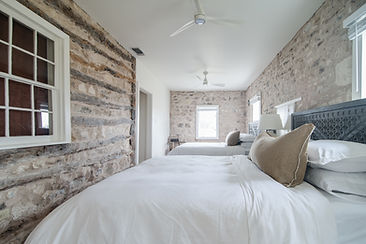
Sleep in the original 1880 cabin
Circa 1908
Kitchen and living room addition
The Limestone Addition
As the family grew, the cabin grew with it. Around 1908, just before Max Wittig married Alma Louise Eckhardt on March 16, 1909, the family added an L-shaped wing of native limestone wrapping around the original cabin. The new construction created a long combined kitchen and living room, with a back bedroom for the young couple.
It was in that back bedroom that Max and Alma's two sons were born: Guenther on April 27, 1913, and Chester on December 23, 1917. Three generations now lived together under one roof - grandparents in the cabin, parents and children in the limestone wing, all sharing the same hearth.
Circa 1917
The Sandstone Tower
The most striking feature of the house, the three-story sandstone tower with its cellar beneath, was built around 1917. The light brown stone was quarried from the Robert Klett ranch, about a mile southwest of the property. Every block was cut, hauled, and laid by hand.
Once the tower was finished, the entire family began sleeping upstairs in the big room. There was no central heating; on cold nights, someone would climb the stairs and start a fire in the wood-burning stove before bed. Hooks were set into the ceiling so that Alma Wittig could hang her quilting racks. She made many quilts in this room - work that took weeks at a time, the racks lowered for sewing and raised again to clear the floor.


The "Best Room"
1925 - 1927
The Best Room
Around 1925, the Wittigs added a wood-frame extension on the west end of the house. It included a long front porch, a small narrow room (later converted into the home's first bathroom), and what the family always called "the best room" - their formal parlor, kept just-so for visitors and special occasions.
On a spring day in 1927, this room held a funeral. Anna Kramer Wittig, the rancher's daughter who had married a German orphan, raised three children in a log cabin, and lived to see her grandsons born under the same roof, died on April 6 of that year. She was sixty-eight. After the service in this room, the undertaker took her into Fredericksburg for burial in the city cemetery.
1947 - 1957
A Childhood on the Farm
In March of 1947, three-year-old Sandra "Sandy" Wittig moved into the western frame addition, the Best Room, with her parents and brothers. Her grandparents, Max and Alma, lived upstairs in the sandstone tower. The first floor below them served as the family's shared living room and kitchen. The eastern rooms - the original log cabin and the limestone wing - had become storage and her father's workshop.
In 1949, Max and Alma built a small home for themselves at the corner of the farm, fronting Llano Highway. The big house belonged to the next generation. Sandy lived there until 1956, when her family moved to Austin. The following year, her father sold the entire farm to Paul Hohenberger, who would subdivide it into the parcels that exist today.
Decades later, in 2001, Sandy sat down at her kitchen table in Illinois and wrote a long letter recalling everything she could remember about the house - the rooms, the people, the way they had lived. Without that letter, much of what you have just read would be lost.


THE BARN AND THE PEAR TREE
What Has Lasted
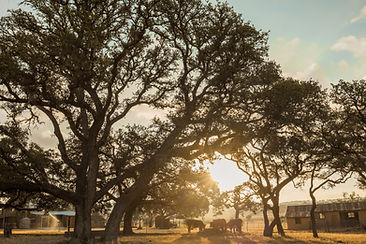
Two original Wittig structures remain on the property today, in addition to the house itself. The barn was built by the Wittigs more than a hundred years ago. They kept dairy cows in the small milk barn attached to it, horses in the main structure, and a beautiful family buggy parked inside. Some of the original tack reportedly hung in the barn for decades after the horses were gone.
In the side yard, a pear tree planted by the family more than a century ago still bears fruit every September and October. It shaded Max Wittig as a boy in the 1890s and Chester as a boy in the 1920s. It is the same tree.
TODAY
Grand Oaks Ranch
The 22 acres that comprise Grand Oaks Ranch today are the heart of what was once the Wittig homestead. The walls around our guests were built by hand from local limestone and sandstone more than a century ago. The barn was raised by hands that have been gone for a hundred years. The pear tree still drops fruit in autumn.
We are honored to be the current stewards of this land and this story. When you stay with us - for a wedding, a retreat, or simply a weekend away - you are sleeping inside walls that have held five generations of family life. Throughout the home, you'll find framed displays in each room that tell the part of the story that took place there.
This history was compiled from original Texas land records, cemetery dates, and a series of letters written between 2001 and 2003 by Chester Wittig (born in this house in 1917) and his cousin Sandra Wittig Timmon. We are grateful to the Wittig family for preserving their story so we could share it with you.
Weddings, retreats, and weekend escapes - we'd love to hear from you.